
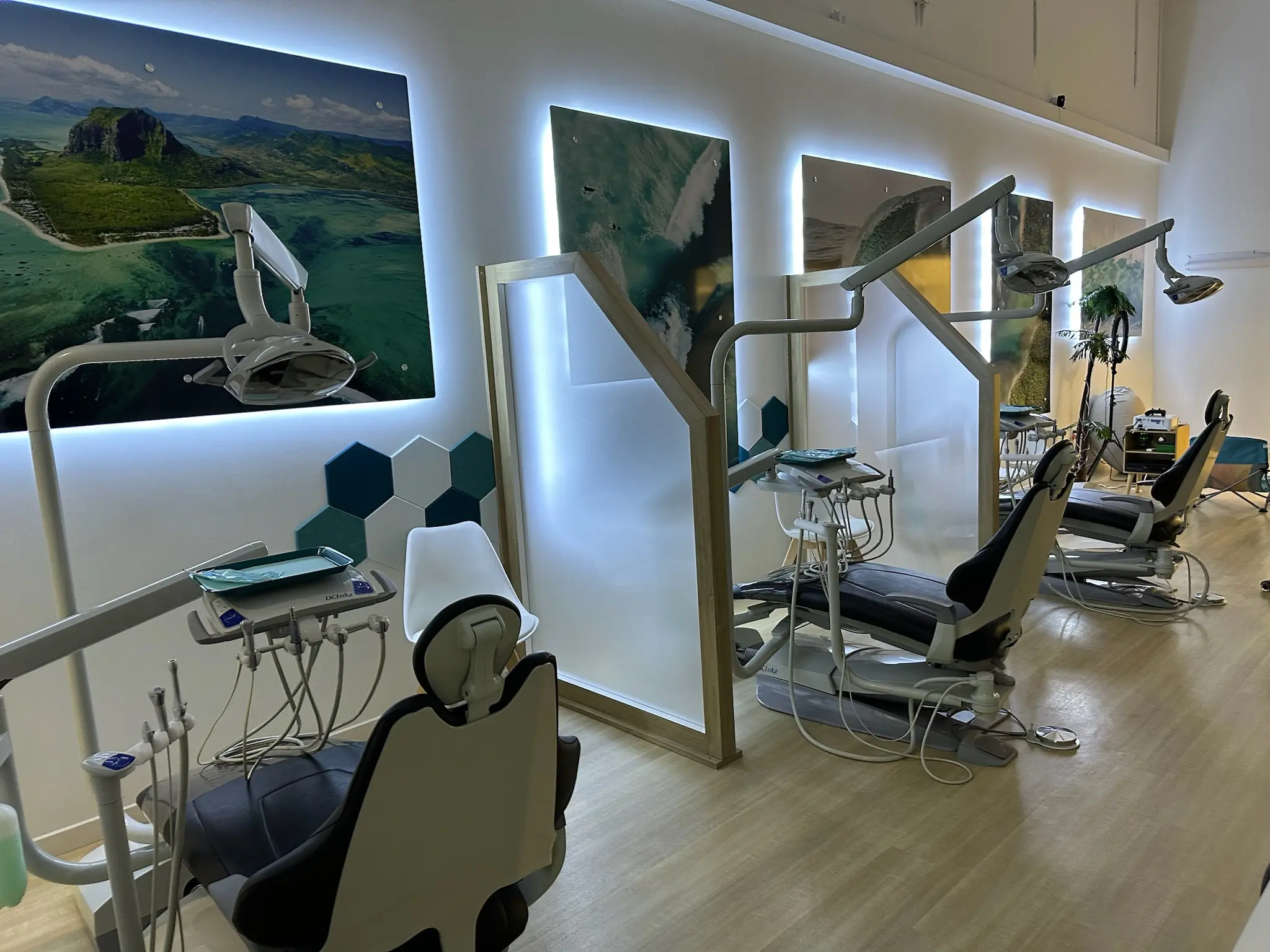
Airway & Sleep Orthodontics at Bold Bite
Orthodontic treatment used to be about straight teeth. Airway orthodontics broadens the lens: how jaw position, palate width, tongue posture, and facial growth affect the ability to breathe properly, especially at night. A narrow upper jaw restricts nasal airflow. A recessed lower jaw crowds the tongue toward the back of the throat. Together those structural patterns cause snoring, fragmented sleep, daytime fatigue, and in diagnosed cases contribute to obstructive sleep apnea (OSA).
A custom mandibular advancement device (MAD) is one orthodontic answer for adults. Two digitally scanned trays hold the lower jaw forward 4 to 8 mm during sleep, pulling the tongue away from the airway and keeping the soft tissue from collapsing. No mask, no hose, no machine noise. For the right patient, research shows oral appliances reduce snoring meaningfully and can treat mild-to-moderate OSA comparably to CPAP in terms of symptom improvement and long-term adherence.
At Bold Bite Orthodontics, the MAD is not a standalone product. It sits inside a coordinated airway plan that begins with screening at the first consultation, a Vatech Green CBCT scan, AI-assisted airway analysis, and a referral to a sleep medicine physician or ENT for the formal diagnosis. Dr. Marty Greenberg and Dr. Trang Cao fabricate and fit the appliance; the physician diagnoses and prescribes.
Bold Bite Does Not Diagnose Sleep Apnea
Who Needs an Airway Screening
Airway screening is not an adults-only topic. The causes, the treatments, and the urgency differ between a growing child and a fully grown adult, but both groups need evaluation when symptoms appear. Bold Bite Orthodontics screens every new-patient consultation — not only the patients who show up asking about snoring.
Adults: snoring, fragmented sleep, daytime fatigue
Primary candidates for the mandibular advancement device are adults who snore regularly, wake up with dry mouth or a sore jaw, feel unrested after a full night of sleep, or have been told by a bed partner that breathing pauses at night. Adults who already have a sleep study and a diagnosis of mild or moderate OSA, and who either cannot tolerate CPAP or prefer a portable alternative for travel, are often well-suited to an oral appliance. Adults with severe OSA, central sleep apnea, or anatomical obstruction requiring surgery are routed to the appropriate specialty instead — the MAD is not the right tool for every case.
Children and teens: growth-driven, not appliance-driven
A child who mouth-breathes, snores, grinds their teeth, wakes up tired, has a long narrow face, or struggles with attention at school may have an airway problem — but the treatment is almost never a mandibular advancement device. In a growing child, the jaw, palate, and airway are still forming, and the right answer is structural change: palatal expansion to widen the upper jaw and the nasal floor, removal of enlarged adenoids or tonsils when an ENT confirms obstruction, myofunctional therapy for tongue and lip posture, or functional appliances that guide lower-jaw growth. Bold Bite routes pediatric airway cases through the airway orthodontics, palatal expander, and mouth breathing pages rather than prescribing an adult-style appliance.
Signs the screening flags on the CBCT
During every free consultation, Bold Bite Orthodontics reviews the Vatech Green CBCT scan for six airway indicators: the cross-sectional area at the narrowest point of the pharyngeal airway, adenoid and tonsillar tissue volume, maxillary width and palatal depth, mandibular position and tongue-space volume, nasal septum deviation, and sinus health. When the AI-assisted analysis or the clinical exam flags a constriction, the patient receives a written summary explaining what was seen, the likely downstream effects, and which specialist evaluates each finding next.
How Bold Bite Diagnoses Airway Restriction
Airway screening starts with imaging. Every new-patient comprehensive exam at Bold Bite includes a Vatech Green CBCT scan — an ultra-low-dose 3D cone-beam X-ray that captures the full airway, sinuses, head and neck anatomy, and both jaws in a single 90-second scan. The radiation exposure is a fraction of a traditional panoramic series, which is why Bold Bite scans pediatric patients without hesitation.
What the Vatech Green CT shows
The scan visualizes soft tissue and bone in three dimensions at once: adenoid pad size, tonsil volume, the pharyngeal airway from the soft palate to the epiglottis, tongue position, hyoid position, maxillary width, mandibular length, nasal septum straightness, and sinus opacification. A two-dimensional panoramic radiograph cannot show any of that. The 3D dataset is the foundation of every airway discussion that follows.
AI-assisted airway analysis on every consult
Bold Bite uses AI software to segment the pharyngeal airway from the CBCT, measure the cross-sectional area at every slice, and flag the narrowest point. That automated pass runs on every new-patient scan — not just the patients who ask about the airway. It is the reason airway findings are caught in patients who came in for braces or Invisalign consults and had no prior suspicion their airway was restricted. Dr. Marty and Dr. Cao then review the AI output together and correlate it with the clinical exam before deciding the next step.
What the CBCT cannot tell you
Imaging shows structure, not function. The scan cannot measure oxygen saturation, breathing events per hour, or how many times the airway actually collapsed last night. That data comes from a sleep study — an overnight polysomnogram in a lab or a home sleep apnea test (HSAT) ordered by a physician. Bold Bite screens, refers, and coordinates the formal OSA diagnosis and the prescription for an oral appliance come from a sleep medicine physician or ENT.
Appliance Options for Airway Concerns
There is no single airway appliance. Bold Bite selects the tool that matches the anatomy, the growth stage, and the diagnosis the physician prescribes. The most common options used at the practice:
Mandibular Advancement Device (MAD) — Adults
A two-piece custom oral appliance fabricated from a digital iTero scan. Upper and lower trays interlock with a mechanism that holds the lower jaw 4 to 8 mm forward during sleep, preventing the soft tissue of the tongue and throat from collapsing. Used for primary snoring and mild-to-moderate obstructive sleep apnea in adults who either cannot tolerate CPAP or prefer a portable alternative for travel. Fabrication turnaround is 2 to 3 weeks; delivery, fitting, and titration happen in a 60-to-90-minute office visit.
Palatal Expansion — Growing Children
The roof of the mouth is the floor of the nasal cavity. A narrow upper jaw reduces nasal airway volume, forces mouth breathing, and compromises tongue posture. In a growing child, a palatal expander widens the maxilla at the skeletal level, which enlarges the nasal floor and improves nasal airflow in a way an adult MAD never can. Bold Bite offers auto-expanding options alongside traditional screw-activated RPE and MARPE for older teens and adults whose midpalatal sutures have fused. Details are on the palatal expander page.
Habit-Breaker Appliances
Persistent tongue thrust, thumb sucking, or lip-biting patterns maintain an open bite and reinforce a mouth-breathing posture. Bold Bite fabricates removable and fixed habit-breakers — tongue cribs, hay rakes, and the Angel Aligner tongue crib when aligner treatment is already underway — and coordinates with Southern Speech and Myo, the practice’s primary myofunctional therapy referral partner, when the pattern is neuromuscular rather than purely mechanical.
Angel Aligners with Mandibular Advancement — Adolescent Skeletal Class II
A feature unique to Angel Aligners in the Jacksonville market: clear-aligner therapy paired with a built-in mandibular advancement mechanism for growing patients whose Class II bite is driven by a retrognathic lower jaw. Dr. Cao’s CAGS-level airway training and Dr. Marty’s general-dentistry background combine to pick this option carefully — it is not the right tool for every Class II, but when the growth runway is still open, it advances the mandible during sleep and straightens teeth at the same time.
What the MAD Treats
What the MAD Does Not Replace
How Bold Bite Coordinates with ENT, Allergy, and Sleep Medicine
Airway problems rarely fit neatly inside one specialty. A child with enlarged adenoids, chronic allergies, a deviated septum, and a narrow maxilla needs an orthodontist, an ENT, and an allergist working off the same records. Bold Bite Orthodontics owns the coordination rather than handing it off.
Step-by-Step: From Screening to Appliance
Airway Screening
Dr. Marty and Dr. Cao evaluate jaw position, tongue space, and Vatech Green CT imaging for signs of obstruction.
Physician Referral
Bold Bite refers to a sleep medicine physician or ENT for a sleep study, the only way to measure the AHI and confirm diagnosis.
Diagnosis & Rx
The physician reviews results and prescribes an oral appliance if the patient qualifies. Severe cases may be routed to CPAP or orthognathic surgery instead.
Scan & Fabrication
Digital iTero and Allied Star scan, no goopy impressions. Custom MAD fabricated by a specialty lab. Turnaround is typically 2–3 weeks.
Fitting & Titration
Dr. Marty delivers the appliance, adjusts advancement to the prescribed position, and verifies comfort. Patients begin nightly wear that evening.
Follow-Up & Bite Monitoring
After 4–6 weeks, Dr. Marty evaluates jaw comfort, checks the bite for long-term shifts, and adjusts titration. The physician may order a follow-up sleep study to confirm AHI reduction.
What an Airway Appliance Does Not Do
Straightforward, no-upsell boundaries on the mandibular advancement device. Patients should know what the appliance cannot accomplish before they commit the time and cost to fabrication.
What It Costs at Bold Bite
Bold Bite Orthodontics quotes every airway appliance in writing at the free consultation. No surprise front-desk add-ons, no device-of-the-month promotions, no bundled accessories the patient never asked for. The pricing breakdown below reflects the most commonly delivered airway appliances at the practice.
Custom Mandibular Advancement Device (MAD)
Phase 1 Palatal Expander (growing children)
MARPE (mini-screw-assisted expansion, older teens and adults)
Insurance and financing
Medical insurance (not dental insurance) typically covers oral appliances for diagnosed obstructive sleep apnea under durable medical equipment (DME) benefits. Coverage varies by plan and requires the physician’s diagnosis and prescription described above. Bold Bite provides the documentation the insurer requires and recommends patients verify their medical plan’s DME benefit before starting fabrication.
HSA / FSA accounts reimburse MAD fees when the physician’s prescription is on file.
In-house 0% APR financing is available when a patient prefers to spread the fee.
Discount stacking: military, teacher, first-responder, family, and student discounts do not stack — the patient receives whichever single discount is highest.
Related Airway & Breathing Pages
Airway problems take different forms depending on age and cause. These pages cover the conditions Bold Bite treats and the appliances used:
Related Treatments
MARPE Expansion
Widens the upper jaw at the skeletal level, increasing nasal airway volume. For teens and adults with fused midpalatal sutures who would otherwise need SARPE surgery.
Herbst & MARA
Advances the lower jaw forward in growing patients. Same mechanism as the MAD, but uses skeletal growth to make the change permanent rather than nightly.
Surgical Orthodontics (MMA)
For severe OSA. Maxillomandibular advancement repositions both jaws forward permanently. Bold Bite provides pre- and post-surgical orthodontics and coordinates with a maxillofacial surgeon.
