
Why Parents Come to Bold Bite Orthodontics Asking About This Appliance
Most parents who ask about a chin cup are not looking for the chin cup specifically — they are looking for an answer to a pattern they see in their child. The lower third of the face looks taller than other children the same age. Lips sit apart at rest, and closing them takes visible effort. Breathing happens through the mouth, especially during sleep. Sometimes a pediatrician or ENT has already mentioned enlarged adenoids, snoring, or “long face syndrome.”
Orthodontists describe this as a hyperdivergent growth pattern: the lower jaw tracking downward and backward rather than forward. Left unaddressed during the growth years, the pattern can progress into an anterior open bite, chronic mouth breathing, and a facial profile that usually cannot be corrected without jaw surgery once growth has ended. Bold Bite Orthodontics sees these cases routinely at its Jacksonville office serving Jacksonville Beach and Neptune Beach families, and most of the time the treatment plan does not include a chin cup. The plan usually centers on airway evaluation, palatal expansion, posterior eruption control, and — for open bite specifically — Angel Aligners with anterior extrusion combined with posterior intrusion. Those pathways are covered in detail on the airway orthodontics and open bite pages.
Occasionally, however, a growing child presents with a genuinely steep mandibular plane angle, confirmed vertical skeletal excess on the Vatech Green CBCT, and active growth measured on the cervical vertebral maturation (CVM) stages. For that narrow slice of cases, a vertical pull chin cup used alongside a palate expander, bite blocks, or fixed appliances can add a layer of control the other tools cannot. This page explains what the appliance does, what the research actually shows (including the limitations), and why it is used sparingly at Bold Bite.
If these signs sound familiar: The evaluation window that matters is ages 7 to 12, during mixed dentition and active skeletal growth. Dr. Cao and Dr. Marty see every consultation together as a married two-doctor team and will tell honestly whether growth modification with a chin cup is appropriate, whether another appliance fits the case better, or whether the right answer is simply to monitor. Schedule a complimentary evaluation.
How the Vertical Pull Chin Cup Works
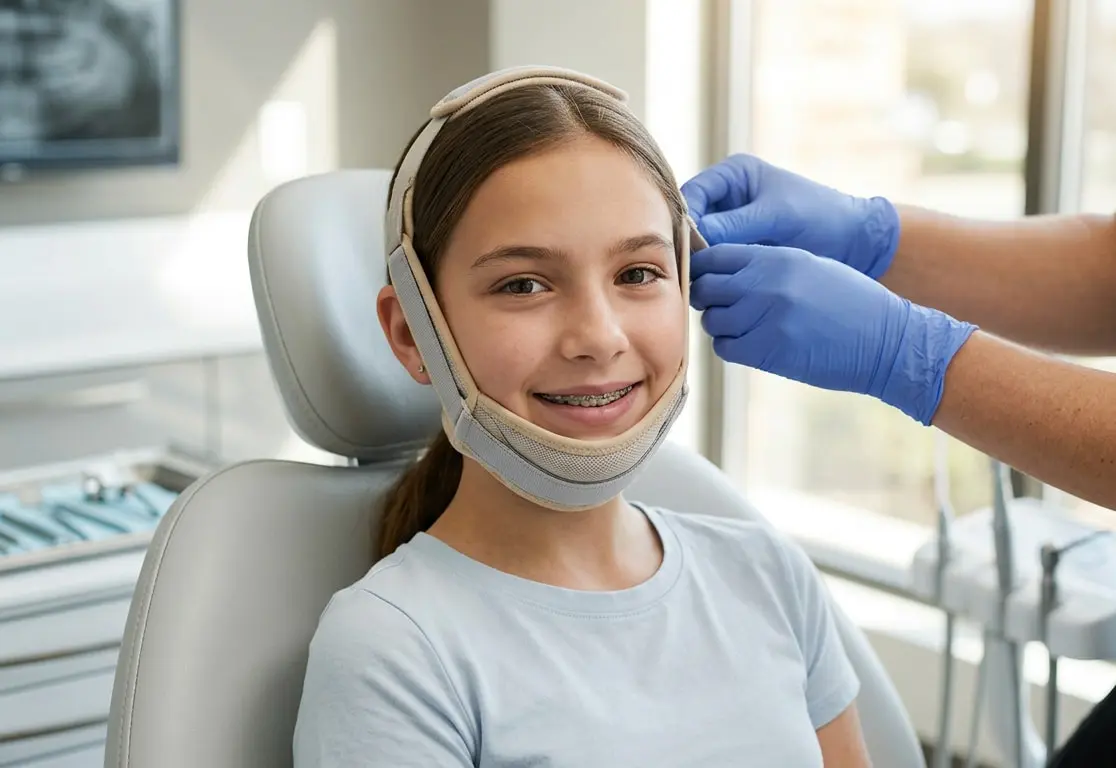
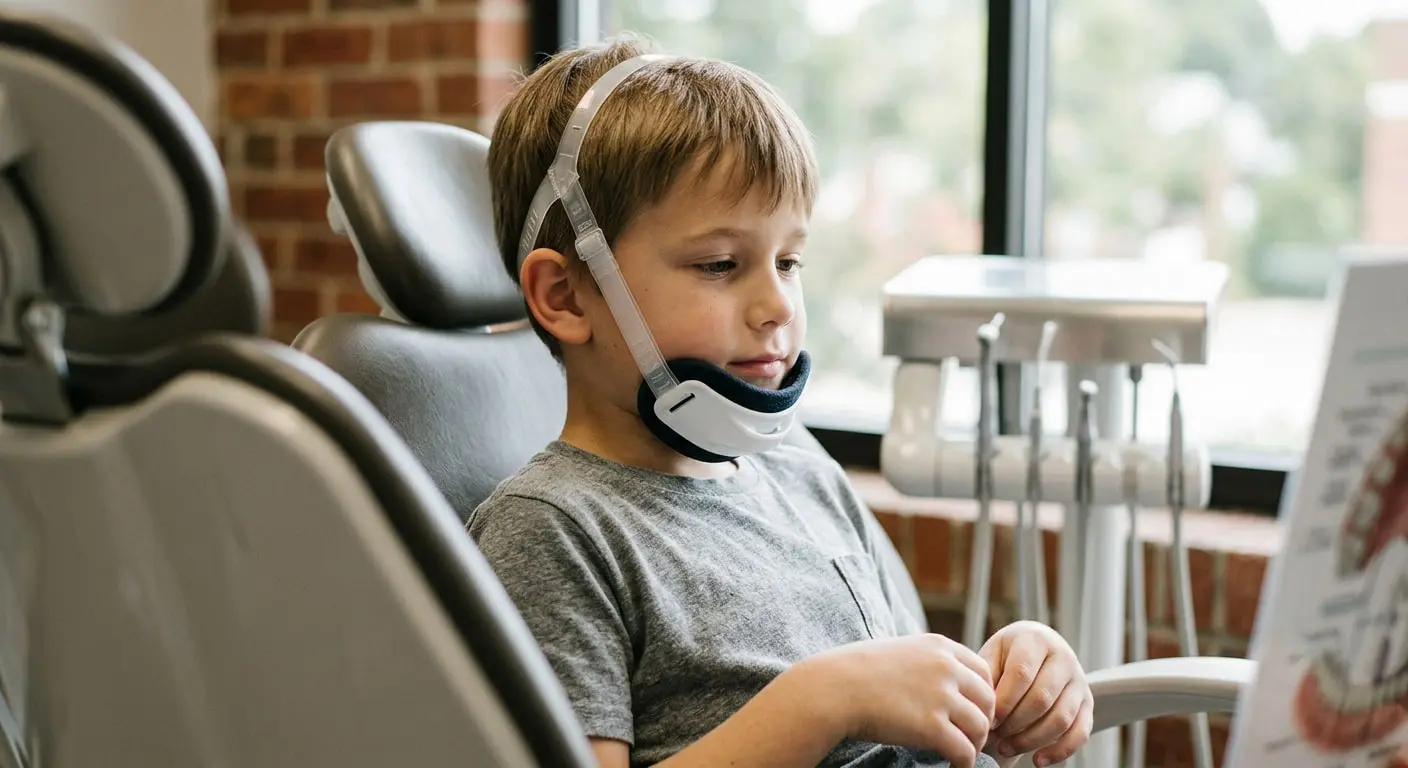
A padded cup sits under the chin. Adjustable straps wrap over the top of the head, applying gentle upward force straight up, perpendicular to the biting surface. In theory, that vertical load does two things: it discourages the lower jaw from continuing to rotate downward and backward during growth, and it encourages posterior teeth to erupt less aggressively, which helps close a developing open bite.
The calibrated force is typically 300 to 500 grams per side, similar to the weight of a soup can. Wear time is 12 to 14 hours per day — evenings, overnight, and weekend mornings. The appliance is never worn to school, sports, meals, or social settings. Most children adjust within about a week, with two to three days of mild chin pressure being normal at the start.
What the Chin Cup Does Not Do
A chin cup influences vertical skeletal growth direction during the active growth years only. It does not straighten teeth, correct crossbites, expand a narrow palate, close spaces, or substitute for braces or aligners. It also does not work in an adult whose growth has finished — at that point, corrective options move to orthodontic camouflage or orthognathic surgery. The chin cup is always one piece of a multi-appliance plan designed around a specific growth pattern, never a standalone treatment.
Vertical Pull vs. Occipital Pull vs. Reverse-Pull Facemask
Three related extraoral appliances are often confused. The vertical pull chin cup pulls the chin straight upward and is considered for excessive vertical skeletal growth (long face pattern, developing open bite). The occipital pull chin cup directs force backward and has historically been used for Class III underbites, though modern evidence and clinical practice almost always prefer a reverse-pull facemask combined with palatal expansion for growing children with skeletal Class III — the facemask-RPE protocol recruits the upper jaw forward rather than restraining the lower jaw backward, and the long-term skeletal stability is better documented.
For adolescents and adults whose growth has ended, neither chin cup nor facemask is the answer — skeletal Class III correction moves to orthodontic camouflage with aligners or braces, or orthognathic jaw surgery coordinated with an oral and maxillofacial surgeon. Dr. Marty (DMD, MS, Jacksonville University) and Dr. Cao (DMD, Specialty Certificate in Orthodontics and CAGS from Jacksonville University, Diplomate of the American Board of Orthodontics) match the appliance to the actual skeletal diagnosis and the patient’s growth stage, not to a one-size-fits-all protocol.
Children Who Benefit from the Vertical Pull Chin Cup
Not every child with an open bite or mouth breathing needs a chin cup. Dr. Marty evaluates the skeletal measurements on your child’s 3D CT scan, mandibular plane angle, lower facial height ratio, and gonial angle, before recommending this appliance. Candidates typically share several of these characteristics:
Increased Lower Face Height
Nose-to-chin distance is disproportionate. Mandibular plane angle exceeds 35 degrees on lateral cephalogram.
Open Bite or Tendency
Front teeth don’t overlap when biting down, or they barely touch. Back teeth may be the only ones making contact.
Mouth Breathing at Rest
Lips habitually apart. Breathing through the mouth, especially during sleep. May involve a tongue thrust habit.
Downward & Backward Growth
Chin appears receding. Face looks convex from the side. Growth records show the jaw tracking downward instead of forward.
Age 7–12 & Still Growing
Must be in mixed dentition with active skeletal growth. Confirmed with cervical vertebral maturation (CVM) assessment.
Adequate Compliance
12–14 hours/day for 6–18 months. If your child struggles with compliance, Dr. Marty may recommend alternative approaches first.
Honest Limits: What Accelerated Treatment Will Not Do
Free Consultation + 3D CT
CBCT scan, skeletal measurements, vertical growth assessment. Diagnosis, treatment plan, and exact pricing. No charge, no deposit.
Appliance Fitting
Custom-fitted to your child’s head. Straps adjusted for truly vertical force. Dr. Marty calibrates to 300–500 grams per side using a force gauge.
Home Wear (12–14 hrs/day)
Worn at home and during sleep. Off for school, meals, sports, brushing. Most children adjust within a week. Mild chin soreness for 2–3 days.
Progress Monitoring
Vertical growth checked every 6–8 weeks. Force level and strap position adjusted as your child grows. Cephalometric measurements at intervals.
Transition to Next Phase
Once vertical control is established (6–18 months), chin cup phased out. Treatment continues with braces. Some children continue nighttime wear.
Long-Term Monitoring
Vertical patterns can reassert during pubertal growth spurt. Dr. Marty monitors through adolescence and adjusts the plan if needed.
What the Research Actually Shows
The older cephalometric literature on vertical pull chin cup is modestly supportive but methodologically limited. Pearson (Angle Orthodontist, 1986) evaluated 79 patients treated with a vertical-pull chin cup and reported close to 10 degrees of mandibular plane angle closure — enough, in those cases, to redirect the jaw from a downward growth path toward forward rotation, shorten the face, and improve lip seal. His earlier work (1973, 1978) established the biomechanical rationale. Iscan et al. (AJODO, 2002) and Schulz and McNamara (AJODO, 2005) confirmed open bite correction through mandibular forward rotation and posterior eruption inhibition, and a 2014 meta-analysis (Chatzoudi et al., 120 patients across five studies) further validated the short-term findings in controlled settings.
The more recent evidence base is less enthusiastic. Most of the supporting studies are small, non-randomized, and measure short-term cephalometric outcomes rather than long-term skeletal stability into adulthood. Systematic reviews of growth-modification appliances generally rate the certainty of evidence for chin-cup therapy as low, note wide variation in patient response, and caution that treated changes may partially relapse once the appliance is discontinued. For the specific subgroup of skeletal Class III, multiple reviews now recommend reverse-pull facemask combined with rapid palatal expansion over chin cup as the better-supported first-line growth-modification protocol.
Why Most Orthodontists No Longer Offer This Routinely
Most current residency programs spend very little time on vertical growth modification with extraoral appliances. The focus of modern training is on aligners, fixed appliances, and bone-anchored mechanics. That shift reflects where the evidence and the manufacturer investment have gone, not a gap parents need to worry about. If a child was evaluated by another orthodontist and told to “wait and see” or offered braces without any plan for vertical control, that may simply be that orthodontist’s honest read of the case — not a missed opportunity. The question Dr. Marty and Dr. Cao ask at Bold Bite is whether this child, on this CBCT, at this growth stage, will measurably benefit from the appliance, or whether the skeletal problem is better addressed with expansion, aligner-based open bite mechanics, myofunctional therapy, or an eventual surgical plan after growth ends.
The Honest Takeaway
How the Chin Cup Fits into a Larger Plan
The chin cup is rarely used alone. On the rare cases where it is indicated at the Jacksonville office, Dr. Marty and Dr. Cao design a phased treatment plan that addresses all three dimensions — arch width, anteroposterior position, and vertical height — simultaneously:
Expander (RPE) + Chin Cup
Posterior Bite Blocks + Chin Cup
Braces + Chin Cup (Nighttime)
Chin Cup + Myofunctional Therapy
Cost
Chin Cup: Included in Treatment Fee
No separate charge for the appliance, fitting, adjustments, or progress imaging. Total treatment cost depends on the full plan (expander, braces, other appliances), starting from 4,500 for comprehensive cases.
Bold Bite Orthodontics accepts all major PPO dental insurance and files claims on the patient’s behalf. Insurance details → · Military, teachers, first responders, healthcare workers, and students receive a community discount. View all discounts →
